Rhodes Private Taxi Services

Transfers and private tours of Rhodes

[Home] [Cars and Drivers] [VIPs Services] [Testimonials] [Travel Tips] [Contact us]

The world-famous Colossus of Rhodes

Is connected to the siege of the town by Dimitrios the Besieger in 305 B. C.. Proud of their great victory the Rhodians decided with the funds they raised from the sale of Dimitrios ' siege equipment to erect a triumphal statue to their great god, Helios. The work was assigned to Chares of Lindos who worked on it for twelve years (304 to 292 B.C.)

Despite the fact the Colossus was considered one of the seven wonders of the ancient world, both a technical and artistic masterpiece, there is a lack of vital information concerning the site it occupied and its actual shape. It is calculated to have been about 31 meters high.

It is said that Chares cast the, bronze limbs of the statue very slowly, on the spot, within enormous mounds of earth, moving from the bottom upward, just as one would build a house.

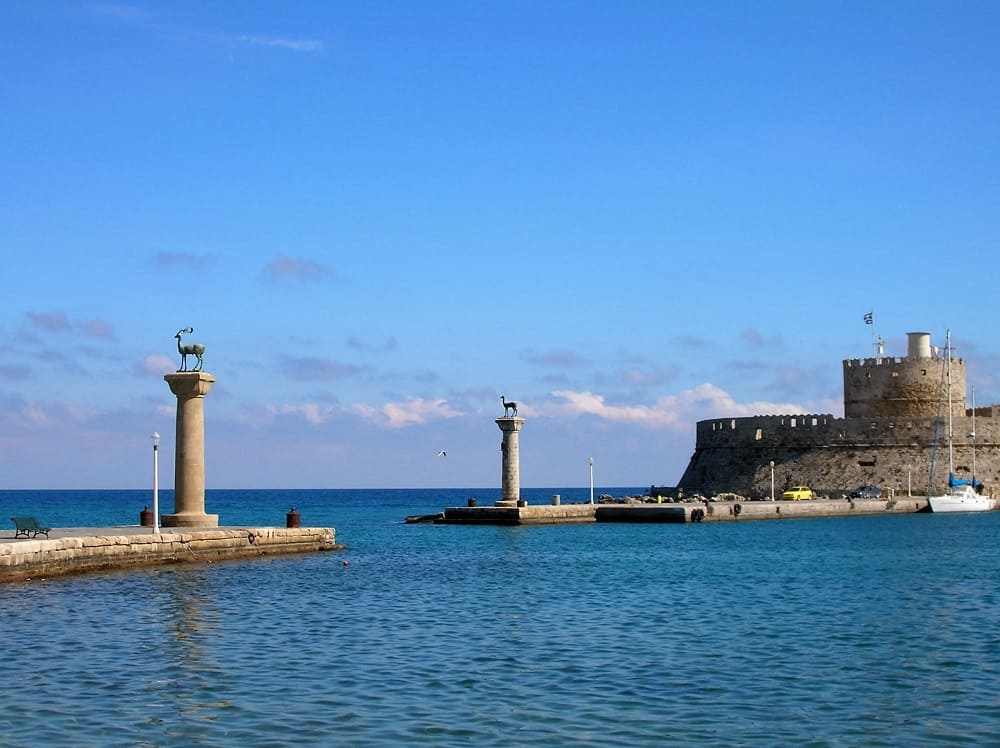
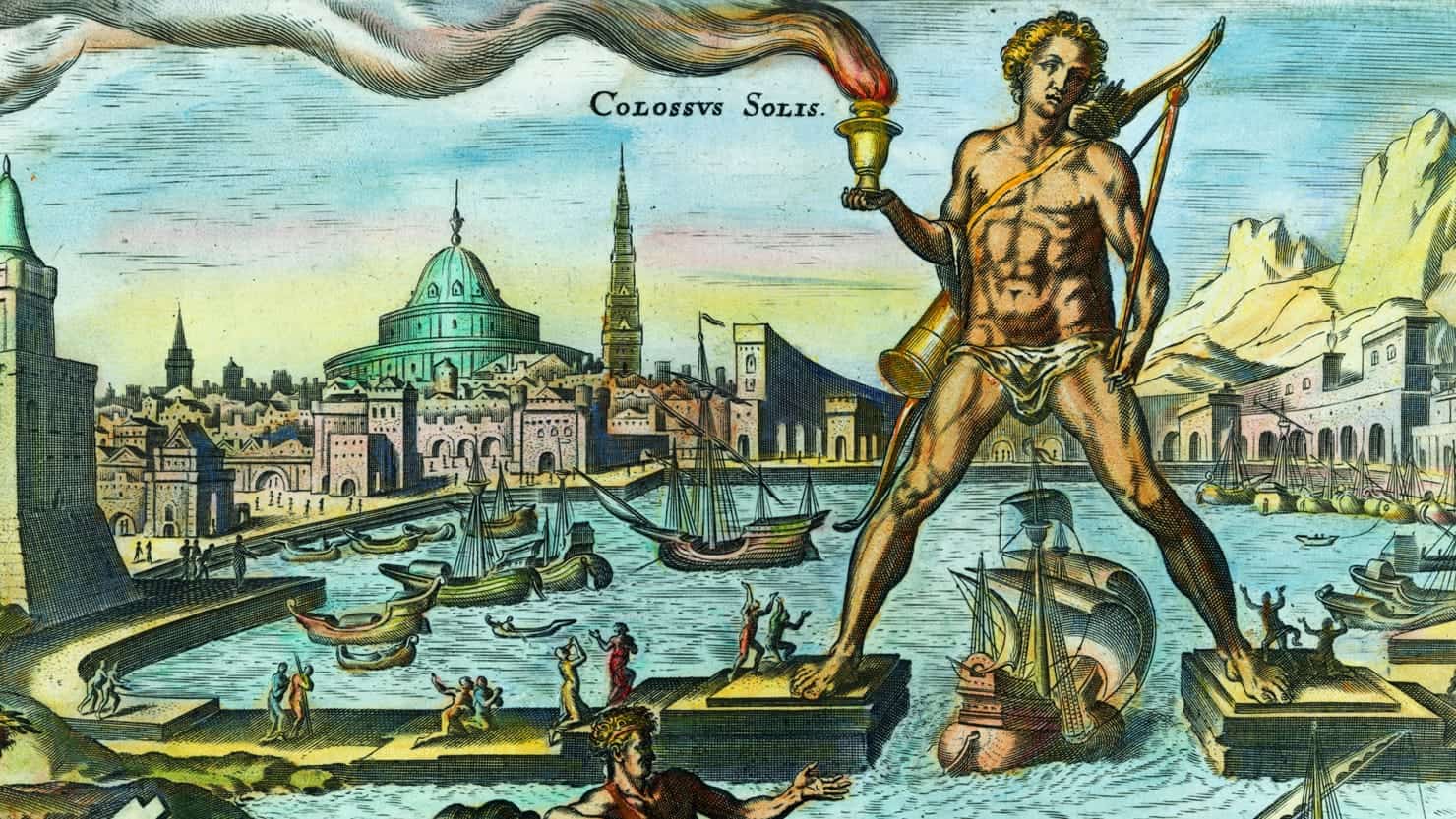
According to one account, the Colossus stood across the entrance to the harbor allowing ships to pass between its open legs. To day it is almost certain it stood on dry land and that the most likely site was the enclosure of the temple of Helios, near the palace of the Grand Masters.

But this "wonder" stood for no more than 66 years. During a severe earthquake in 266 BC It cracked at the knees and fell. The Rhodians, fearing a curse, did not reerect it and it lay there in a heap for many centuries. ' But in 653 A. D. when the Arabs of Moab pillaged Rhodes, they sold the pieces to a Jewish merchant. Tradition says that it took 900 camels to transport it. But the legend surrounding it was so closely tied to Rhodes, that for many centuries both Greeks and Westerners called the Rhodian people "Colossians".

The statue of Colossus today

Media reports in 1989 initially suggested that large stones found on the seabed off the coast of Rhodes might have been the remains of the Colossus; however this theory was later shown to be without foundation.
There has been much debate as to whether to rebuild the Colossus. Those in favour say it would boost tourism in Rhodes greatly, but those against construction say it would cost too large an amount (over 100 million euro). This idea has been revived many times since it was first proposed in 1970 but, due to lack of funding, work has not yet started.

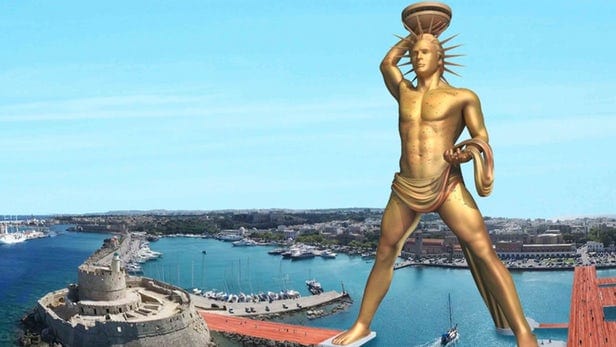
Finally, everyone on the island of Rhodes have agreed to rebuild the statue of Colossus one of the seven wonders of the ancient world is to be rebuild the experts said. The only major issue is how to program such a project and who the investors will be. There has been a discussion, whether the municipality of Rhodes city will offer the capital Itself or all islands municipalities together or the Greek government. Although such a project since if projects the history of Rhodes, and at the same time the history of the Europe it could be financed by the European Union completely. Another issue is to build this statue in a way that if would look like the original one for sure no one knew how it looked like. Another question; where the statue is to be placed ?
The Archaeologists have different opinions about it's location in the past. The experts say that it would be better for this statue to be built in front of the port and at a distance from it so that it can be seeing from any direction.

The fact that "Liberation" the French newspaper supports the aspect that Colossus should be rebuilt shows that the whole common European aspect can initiate all the efforts at the same direction.

Several months ago at the "1st Rhodes international travel forum", Colossus was one of the head subjects that were discussed. The conclusion coming up after all is that this project known as one of the destroyed seven wonders will rise up the European heritage on civilization.


 

Private sightseeing tours of Rhodes Island
Rhodes Island private sightseeing tours
Private sightseeing tours of Rhodes Island
Rhodes Island private sightseeing tours

Part of Discovery Channel's documentary "Seven Wonders of Ancient Greece"


The Colossus Of Rhodes


The Guardian, Monday 17 November 2008

Colossus of Rhodes to be rebuilt as giant light sculpture

It may not straddle the port as its predecessor once did, but in terms of sheer luminosity and eye-catching height the new Colossus of Rhodes will not disappoint. Nor will it fall short of the symbolism that once imbued the ancient monument.
Twenty-three centuries after craftsmen carved the legendary statue that has inspired legions of painters, poets, playwrights and politicians, a new world wonder, built in the spirit of the original Colossus, is about to be born on the Aegean island.
After decades of dashed hopes, the people of Rhodes will fulfil a long-held dream to revive one of the world's seven ancient wonders - thanks to the promise of international funding and the East German artist Gert Hof.
"It will be a unique architectural creation," said the island's mayor, Hatzis Hatziefthimiou, presenting what is likely to become one of the 21st century's largest artistic projects in Dubai last week.
"We want to make it a work of global appeal and significance."
Like the original, erected in homage to the sun god Helios by the master sculptor Chares of Lindos, the new Colossus will adorn an outer pier in the harbour area of Rhodes, and be visible to passing ships.
And like its ancient namesake, the modern-day wonder will be dedicated to celebrating peace and built, at least in part, out of melted-down weapons from around the world.
But unlike the ancient Colossus, which stood 34 metres high before an earthquake toppled it in 226BC, the groundbreaking work of art is slated to be much taller and bigger. And unlike previous reconstruction efforts, officials say the Cologne-based design team is determined to avoid recreating a replica.
In the past, new Colossus aficionados have persistently run up against the objections of Greece's powerful lobby of archaeologists.
A proposal to recreate the legendary statue in the run-up to the 2004 Athens Olympics whipped up such controversy that opponents claimed its glitzy, we're-bigger-than-you overtones were not only offensive but defiled rather than boosted the country's cultural heritage.
"Monumental works can't be copied for the simple reason that they risk becoming caricatures," insisted Hatziefthimiou.
Instead, in the spirit of the 21st century the new Colossus has been conceived as a highly innovative light sculpture, a work of art that will allow visitors to physically inspect it by day as well as enjoy - through light shows - a variety of stories it will "tell" by night.
"We are talking about a highly, highly innovative light sculpture, one that will stand between 60 and 100 metres tall so that people can physically enter it," said Dr Dimitris Koutoulas, who is heading the project in Greece.
"Although we are still at the drawing board stage, Gert Hof's plan is to make it the world's largest light installation, a structure that has never before been seen in any place of the world."
The statue is also expected to cost up to €200m according to yesterday's Vima newspaper. But, in another first that has also been welcomed by the people of Rhodes, international organisations led by the World Trade Centre Association, a network of exporters who promote peace through trade, have weighed in with financial help.
"The new Colossus has been the dream of Rhodians for many years," said Yannis Hadzimarkos, president of the Dodecannese Islands' Chamber of Commerce which is also supporting the project. "It will be a marvellous opportunity for the economy of the region even if it is naive to think it will be easy."